
A busy family home does not need more complicated rules. It needs simple systems that make everyday tasks easier for everyone who lives there. The most useful organizing ideas reduce searching, shorten cleanup, and help children and adults know what happens next.
Family clutter is rarely one person’s fault. It is often the visible result of many people moving through the same spaces with different schedules, ages, habits, and needs. Backpacks arrive while dinner is being prepared. Shoes come off near the door. Papers travel from school to the counter. Laundry keeps moving even when everything else is busy.
The answer is not to turn your home into a showroom. It is to make the home easier to use. A thoughtful family system creates fewer decisions at the busiest moments and gives everyone a realistic way to participate.
Why is it so hard to keep a family home organized?
A family home changes constantly. Children grow, schedules shift, sports seasons begin, work becomes demanding, and belongings enter faster than anyone notices. A system that worked last year may no longer match the people using it.
Many homes also ask one person to carry most of the invisible organizing work: remembering what is running low, locating missing items, deciding where new things belong, and prompting everyone to reset. When only one person understands the system, that person becomes the system. The result is exhausting and fragile.
Useful home organizing makes responsibility more visible. It places things where people naturally use them, uses labels or cues everyone can follow, and creates a few predictable routines. It will not eliminate busy seasons, but it can make them much less chaotic.
Where should a busy family start organizing?
Start with the moment that causes the most repeated frustration. Do not begin with the largest room simply because it looks impressive. Begin with the part of the day that regularly makes someone late, upset, or overwhelmed.
- If mornings are frantic, begin with shoes, bags, coats, and breakfast supplies.
- If dinner feels impossible, begin with one kitchen work zone or the weekly meal plan.
- If papers disappear, begin with incoming mail and school forms.
- If evenings unravel, begin with a ten-minute family reset and preparation for tomorrow.
- If laundry covers several rooms, begin with where clothes are removed, collected, and returned.
Choose one measurable improvement. “Everyone can find what they need to leave the house” is more useful than “make the entryway beautiful.” A clear purpose helps you decide what belongs in the space and what does not.
How do you create a family drop zone that works?
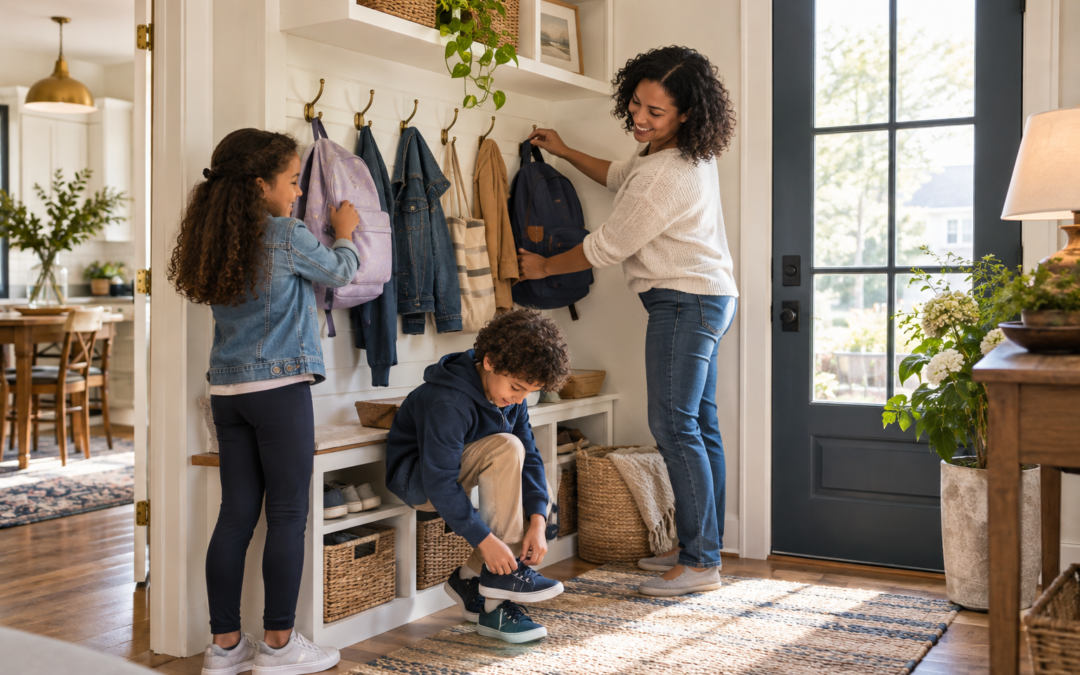
A family drop zone gives everyday leaving-the-house items a home near the entrance you actually use. It can be a mudroom, a section of hallway, a wall beside the garage door, or one shelf and a few hooks. Size matters less than location and simplicity.
Assign a reachable place for each person
Hooks should be at a height the user can reach. Baskets or cubbies can hold shoes, hats, sports gear, or the items that travel together. Young children may need a picture cue or one broad basket. Teenagers may prefer a hook and charging spot. Adults need a place for keys, wallets, and work bags that does not compete with children’s belongings.
Include a next-action spot
Create one place for library books to return, packages going out, signed forms, and items that must leave tomorrow. The container should not become permanent storage. Give it a cue for movement, such as checking it when shoes go on or when the evening alarm sounds.
Leave breathing room
A drop zone packed with every coat and every pair of shoes will be difficult to use. Keep the current season and current activities closest to the door. Store backups and out-of-season items elsewhere. Empty space is functional; it allows the system to receive a busy day.
How can families organize school papers and household paperwork?
Paper needs a short path from arrival to action. Begin with one inbox for mail and one predictable place for school papers. Broad categories such as “action,” “file,” and “recycle” are often enough. The system should make the next decision clear instead of asking you to build a perfect filing cabinet first.
Choose a regular time to empty the action folder. Pair it with an existing routine: Sunday calendar planning, paying bills, or preparing backpacks. Keep a pen, stamps, and frequently used information nearby so one small task does not require a search through the house.
Children’s artwork and keepsakes deserve limits that feel generous but manageable. Give each child a portfolio, bin, or defined shelf. Photograph oversized pieces if that feels meaningful, and invite children to help choose favorites. The goal is not to save nothing. It is to make the saved pieces easier to enjoy.
A family system should serve the family
If the system creates more reminders, more sorting, and more work for one person, it is not finished yet. Simpler categories and easier access usually create better participation than stricter rules.
What is the easiest way to organize family laundry?
Look at the entire path: where clothes come off, where dirty laundry waits, when it is washed, where clean items land, and how they return to bedrooms. The bottleneck may not be the washing machine. It may be sorting, folding, or putting clothes away.
Place hampers where clothes are removed. Use separate hampers only if sorting in advance genuinely saves time. Consider whether every item needs to be folded. Children may successfully put pajamas, socks, or play clothes into broad drawers or baskets. A simple system that gets completed is more useful than a detailed system that creates a clean-laundry mountain.
Give each family member a clear role that fits their age and schedule. A young child can place dirty clothes in a hamper. An older child can carry a basket, match socks, or return clothing to drawers. Shared responsibility is not only about finishing laundry; it teaches where things belong and reduces the need for one person to manage every step.
How do you organize toys without constant cleanup?
Reduce the number of decisions required to put toys away. Broad categories—blocks, vehicles, pretend play, art, stuffed animals—are easier to maintain than dozens of narrow types. Use containers children can reach and open. Add picture labels for children who are not reading yet.
Keep container size connected to the category. When the block bin is comfortably full, new blocks require a choice rather than a larger overflow pile. Rotate some toys if a smaller selection improves play and cleanup. Rotation is helpful only if the stored toys are labeled and can return without creating another forgotten collection.
Notice where children actually play. If toys travel to the family room every day, a small toy home may belong there. Forcing everything into a distant playroom can create an endless migration. Organizing should work with family behavior whenever possible.
What kitchen systems make family life easier?
A family kitchen works best when food and tools are arranged around routines. Create a breakfast zone, lunch-packing zone, snack area, or beverage station if those activities happen often. Store related items together and within reach of the people using them.
Place child-approved snacks where children can choose independently, if that works for your household. Use clear categories rather than transferring every product into matching containers. Decanting can look beautiful, but it adds labor and can hide expiration information. Choose it only when it solves a genuine problem.
Keep a small “eat first” area for open or soon-to-expire food. Make a short meal plan based on your actual week, including easy nights and leftovers. The purpose is not culinary perfection. It is reducing the 5 p.m. decision load.
How can a family share the mental load of staying organized?
Start by making the work visible. List recurring tasks and the decisions attached to them. “Soccer” may include washing a uniform, filling a water bottle, checking the schedule, arranging transportation, and replacing outgrown gear. When the full task is visible, responsibility can be shared more fairly.
Give ownership rather than repeated reminders where possible. If someone owns pet supplies, that role includes noticing when food is low and adding it to the list. If a child owns backpack reset, create a short visual checklist they can follow. Expectations should be specific, age-appropriate, and supported by a workable environment.
Use one family calendar or communication hub. It can be digital, paper, or both, but everyone should know where the reliable information lives. A system scattered across text messages, school portals, sticky notes, and memory will create stress even in an organized room.
How do you maintain an organized family home during busy weeks?
Plan for busy weeks instead of treating them as exceptions. A resilient system has a minimum version. The entryway may not be perfectly reset, but shoes return to the basket. Laundry may not be folded, but clean clothing stays separated by person. The kitchen may not sparkle, but the sink and one work surface are ready for morning.
Choose a ten-minute family reset at a consistent time. Put on music, set a visible timer, and let each person handle a clear zone. Stop when the timer ends. A short reset that happens often is more effective than a large cleanup everyone dreads.
Keep a donation bag in an accessible location. When clothing no longer fits or a toy is no longer wanted, it has somewhere to go immediately. Schedule the next step—placing the bag in the car or visiting a donation center—before the bag becomes permanent storage.
How can parents organize without becoming the “stuff police”?
Invite participation in decisions that affect shared spaces. Ask what makes an item easy to put away, what category name feels obvious, and what part of the routine is frustrating. Children are more likely to use a system they helped shape.
Focus on function instead of moral language. A toy on the floor is not “bad”; it is a tripping hazard or an item that needs an easier home. A crowded drawer is not a character flaw; it may contain too many categories. Neutral observations make problem-solving safer.
Respect private belongings and sentimental attachments. Parents can set reasonable space and safety boundaries without making every decision for a child. Learning to choose what matters is part of learning to organize.
When should a busy family hire a professional organizer?
Professional help can be valuable when the same problem keeps returning, one parent is carrying too much of the household load, a transition has disrupted old routines, or the project is difficult to start alone. You do not need an extreme amount of clutter to deserve support.
An organizer can see the household with fresh eyes, break a large project into steps, and create systems that fit each family member. The work may focus on an entryway, kitchen, children’s rooms, paperwork, storage areas, or a whole-home plan completed over time.
WOW Organizing works without judgment. We are not there to decide what a family should look like. We listen to what is hard, what matters, and how your days actually move. Then we build practical solutions around your life.
Frequently asked questions about organizing a busy family home
How can I get my family to put things away?
Make the correct action obvious and easy. Reduce the distance to storage, remove unnecessary lids or hangers, use broad categories, and involve family members in choosing the system. Clear expectations and short shared resets work better than one person repeatedly rescuing the room.
Should every family member have matching storage?
No. Consistent colors can make a space feel calm, but each person may need a different kind of cue or container. Matching is optional. Usability is essential.
How much time should we spend resetting the house?
Start with five to ten minutes. Focus on the areas that affect tomorrow: dishes, the entryway, essential papers, and needed clothing. Stop before the reset becomes a nightly argument.
Can a professional organizer work with children?
Yes. Children can be included in age-appropriate ways, especially when we are creating systems for their belongings. The goal is to support independence and respect—not demand adult-level decision making.
Does WOW Organizing help busy families near Roanoke?
Yes. WOW Organizing helps families in Roanoke, Salem, Radford, the New River Valley, Lynchburg, and surrounding Virginia communities. Virtual organizing is also available for families outside the local area or anyone who prefers remote guidance.
What is one family organizing change you can make today?
Choose one repeated question: “Where are my shoes?” “What do I need for tomorrow?” “Where does this paper go?” Create one visible answer near the place the question begins. A hook, basket, tray, label, or checklist can remove a surprising amount of daily friction.
You do not have to solve the whole house this weekend. A home becomes more supportive one useful system at a time.
Ready for calmer family routines?
Tell us which part of the day feels hardest. We will help you create practical, maintainable systems that make room for the people and moments that matter.