
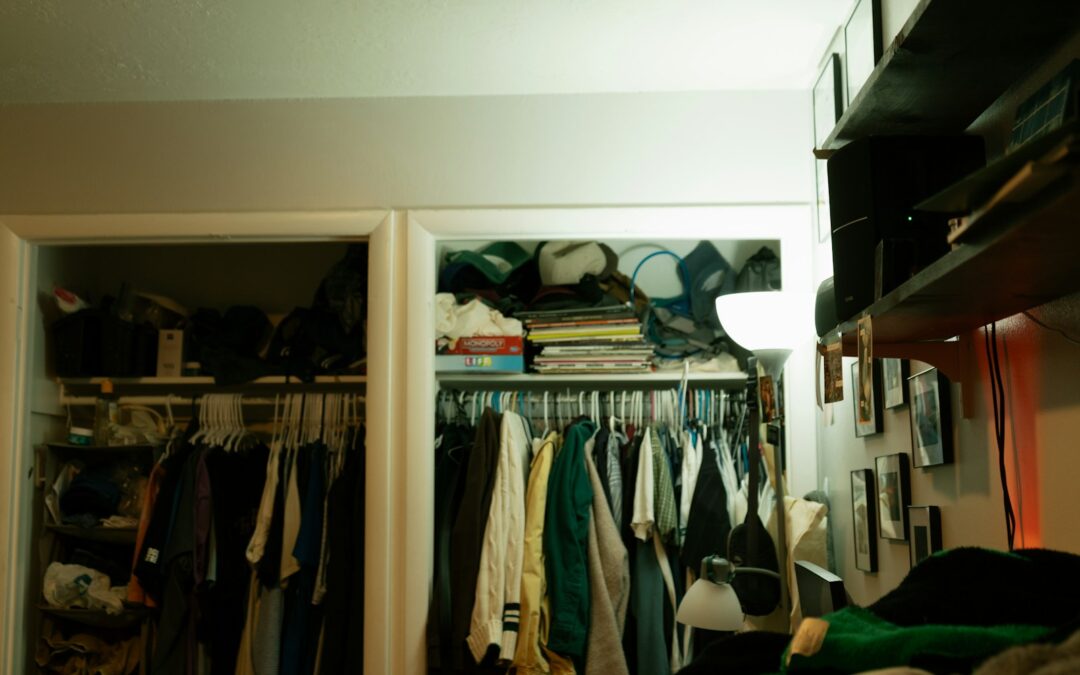
Your closet may keep getting messy because the system asks for more space, steps, memory, or precision than daily life can reliably provide. Repeated clutter is often a system problem—not a personal failure.
If you have organized the closet more than once and watched it slowly return to the same piles, pay attention to where the piles appear. They are evidence. Clothing on a chair, shoes beside the door, and clean laundry in a basket all show which part of the current system is asking too much.
Why won’t my closet stay organized?
A closet will not stay organized when its storage and routines do not match the volume of belongings or the way the space is actually used. An attractive setup can still fail if it is inconvenient to reset.
These are common causes:
There are too many items for the available working space
A closet can technically contain every item and still be too full to use. Packed rods make clothing hard to remove. Full shelves leave nowhere to return laundry. Shoe stacks fall when one pair is pulled out.
The goal is not forced minimalism. It is enough breathing room for the storage to function. If decisions feel overwhelming, use a paced process for decluttering the closet without emptying everything.
Items are stored where they are difficult to put away
Frequently used belongings should have the easiest homes. If everyday shoes live on a high shelf or pajamas require carefully folded stacks, those items will probably land somewhere more convenient.
Watch the natural drop points for one week. A returning pile may need a lower hook, open basket, reachable shelf, or broader category.
The categories are too complicated
Many narrow categories create repeated decisions. A drawer divided into workout tops, lounging tops, undershirts, sleep shirts, and weekend shirts may be less useful than two broad groups that you can reset quickly.
Use the least specific category that still helps you find what you need. Simple is not sloppy. Simple is maintainable.
Putting something away takes too many steps
A system loses reliability with every extra lid, zipper, hanger, stack, and hidden location. If returning one sweater means moving a basket, opening a box, unstacking another box, folding precisely, and rebuilding the stack, the chair will win.
This is especially relevant for people who benefit from visibility and fewer executive-function demands. Our ADHD organizing approach focuses on reducing friction and creating systems around the person using them.
Storage hides what you use most
Opaque bins and deep drawers can make a closet appear calm while useful items disappear. When you cannot remember or see what you own, you may search, rebuy, or create a pile while looking.
Try labels, open-front storage, clear containers, or a more visible location for frequent categories. Closed storage can still work for backups and seasonal items.
The laundry routine stops before the closet
Washing and drying are only part of laundry. Folding, hanging, carrying, and returning clothing are separate steps. If the closet system depends on a perfect folding session, clean clothes may remain in baskets.
Reduce the work where possible. Hang items straight from the laundry area, use broad drawer categories, keep empty hangers together, or create a deliberate home for clothing that will be worn again.
There is no room for new items
Clothing enters through purchases, gifts, children’s growth, changing sizes, hobbies, and new seasons. A system with no available space has nowhere for the next item to go.
Leave some open capacity. Pair seasonal changes or shopping days with a short review of the category. The review is not a punishment for buying something; it keeps the closet connected to current life.
The closet was organized for appearance instead of behavior
Color-sorted clothing and matching containers can be useful, but only if they help you find and return items. If a visual rule adds work without improving daily use, it is decoration rather than a system.
A practical closet might include imperfect stacks, an open basket for workout clothes, or hooks on the door. The system should make sense to the people who use it.
The returning pile is a clue
Do not begin by scolding yourself or buying a larger basket. Ask what the pile contains, where those items are used, and why their assigned home is harder than the place they keep landing.
How can you keep a closet organized?
Make the easiest action the correct action. The system should use clear categories, accessible homes, enough open space, and a realistic connection to laundry and getting-ready routines.
- Place daily items between waist and eye level.
- Use fewer, broader categories.
- Keep a defined place for clothes that are not clean but not ready for laundry.
- Give donations one small container and a regular exit plan.
- Return empty hangers to one location.
- Schedule short seasonal reviews instead of repeated total cleanouts.
- Remove containers that make putting items away harder.
Before shopping, test these changes using what you already own. See how to organize the closet without buying more bins.
When is professional closet help useful?
A professional organizer can help identify why the system repeatedly breaks down, keep sorting and decisions moving, and rebuild the closet around real habits. The work is not about maintaining perfection. It is about creating a space that asks less from you.
WOW’s professional closet organization service works with existing storage and the person using it. You remain in control of every keep-or-let-go decision.
How do you diagnose a closet system that keeps failing?
Study what is out of place, where it lands, and what action would have been required to put it away. That short investigation is more useful than immediately resetting the closet again.
Choose one recurring pile and ask:
- What categories are in this pile?
- Where are their assigned homes?
- Are those homes full, hidden, or hard to reach?
- How many steps does putting each item away require?
- Does the item need a permanent home or a temporary action zone?
A pile of clean laundry points to a different problem than a pile of returns. The first may need simpler clothing storage; the second needs a visible deadline and exit routine.
What is the fastest way to reset a messy closet?
Return obvious items to clear homes, collect unrelated belongings in one relocate basket, and restore a safe floor or walkway first. Do not use a quick reset to hide undecided items in empty containers.
A fifteen-minute reset can:
- Gather empty hangers.
- Move dirty clothing to laundry.
- Place wearable-again clothes in their defined zone.
- Return five easy items.
- Collect donations in one outgoing container.
- Stop before beginning a complete redesign.
The purpose is to make the closet usable today. Deeper sorting can happen in a planned session.
How do you create a closet reset routine?
Attach a short reset to a routine that already occurs, such as putting away laundry or preparing for the week. Keep the reset small enough to finish consistently.
A weekly reset might mean clearing the closet floor, returning empty hangers, checking the in-between clothing basket, and moving donations toward the car. A seasonal reset may include reviewing fit, rotating weather-specific items, and making room for changing routines.
Do not create a maintenance plan longer than the time you realistically have. Five useful minutes repeated regularly can protect the system better than a monthly plan you dread.
Why do shared closets become messy?
Shared closets often fail when ownership is unclear or one system is expected to suit everyone. Each person needs visible territory and a method they can maintain.
Divide rods, shelves, drawers, or baskets deliberately. Labeling can help, but physical boundaries are often clearer. Shared items such as luggage, linens, or special-occasion clothing should have their own area instead of drifting into whichever section has temporary room.
Different systems can coexist. One person may hang most clothing while another needs broad open baskets. Consistency matters within a person’s area more than symmetry across the whole closet.
Why do children’s closets get messy so quickly?
Children’s closets change rapidly because sizes, seasons, school needs, and independence change. A system that worked six months ago may no longer match the child or the amount of clothing.
Keep current, well-fitting clothing in the easiest spaces. Separate clothing to grow into and clothing that no longer fits. Use labels children understand and categories broad enough for them to help. A low hook or open basket may support independence better than a high rod and careful folding.
How does shopping affect closet maintenance?
New items need both physical space and a clear category when they enter the home. Without an intake habit, purchases remain in bags or press existing clothing into tighter storage.
When a new item arrives, remove packaging, decide where it belongs, and check whether the category still functions. This does not require a rigid one-in-one-out rule. It simply keeps the closet connected to what you currently own.
A wish list can also reduce duplicates. Before shopping, check the relevant category so you know whether the need is real or the existing item has simply been hard to find.
What if the closet is tidy but still stressful?
A closet can look tidy and still be difficult if clothing is hidden, categories are unclear, or daily items are inconvenient. Appearance is only one measure of success.
Notice how long it takes to choose clothing, find a specific item, put laundry away, and recover after a rushed morning. A system that requires constant refolding may be visually calm but practically demanding.
Give yourself permission to choose visible labels, broader categories, open baskets, or a less polished arrangement if those choices make the space easier to use.
How often should you reorganize a closet?
You should not need to redesign the entire closet on a fixed schedule. Adjust the system when routines, seasons, clothing sizes, household members, or storage needs change.
Small reviews are normal. A major repeated overhaul is a sign that the underlying friction was never resolved. Before starting over, identify which categories and actions fail first.
Closet maintenance FAQs
Is it normal for an organized closet to get messy sometimes?
Yes. Homes are active spaces. A useful system makes recovery easier; it does not prevent every busy week or unfinished load of laundry.
Should I buy more storage when the closet gets messy?
Not until you understand the cause. More storage can help a defined category, but it can also hide decisions or consume working space.
What is the best closet system?
The best system is one the people using the closet can understand, access, and reset during ordinary life. It may not be the most detailed or visually perfect option.
How do seasonal changes disrupt closet systems?
Seasonal changes disrupt a closet when new categories enter before off-season items have a clear next place. Coats, swimwear, school uniforms, sports gear, and holiday clothing can all compete for the same easy-access space.
Use the change of season as a small review rather than a total closet makeover. Move genuinely inactive items, check fit and condition, and keep transition pieces accessible. Label stored categories specifically so they can return without another search project.
Can a very small closet stay organized?
Yes, but a small closet needs especially clear boundaries and working space. It cannot hold every possible category simply because the door closes.
Prioritize current clothing and the routines connected to that room. Move household storage, luggage, sentimental items, or off-season categories when another appropriate location exists. Use the back of the door or vertical space only when it makes items easier to retrieve and return.
In a small closet, one overfilled category affects everything around it. Short, focused reviews can keep the whole space from reaching the point where every item becomes difficult to access.
Let the closet tell us what is not working.
If you are in Roanoke, Roanoke County, Cave Spring, Salem, or a nearby community, explore our closet organizing help.